System Analysis for Web Development in 2026: What AI Changed — and What It Didn't
From 2022’s Copilot novelty to 2027’s agentic pipelines, the scarce skill moved upstream: clear requirements, contracts, and verification — not faster typing.
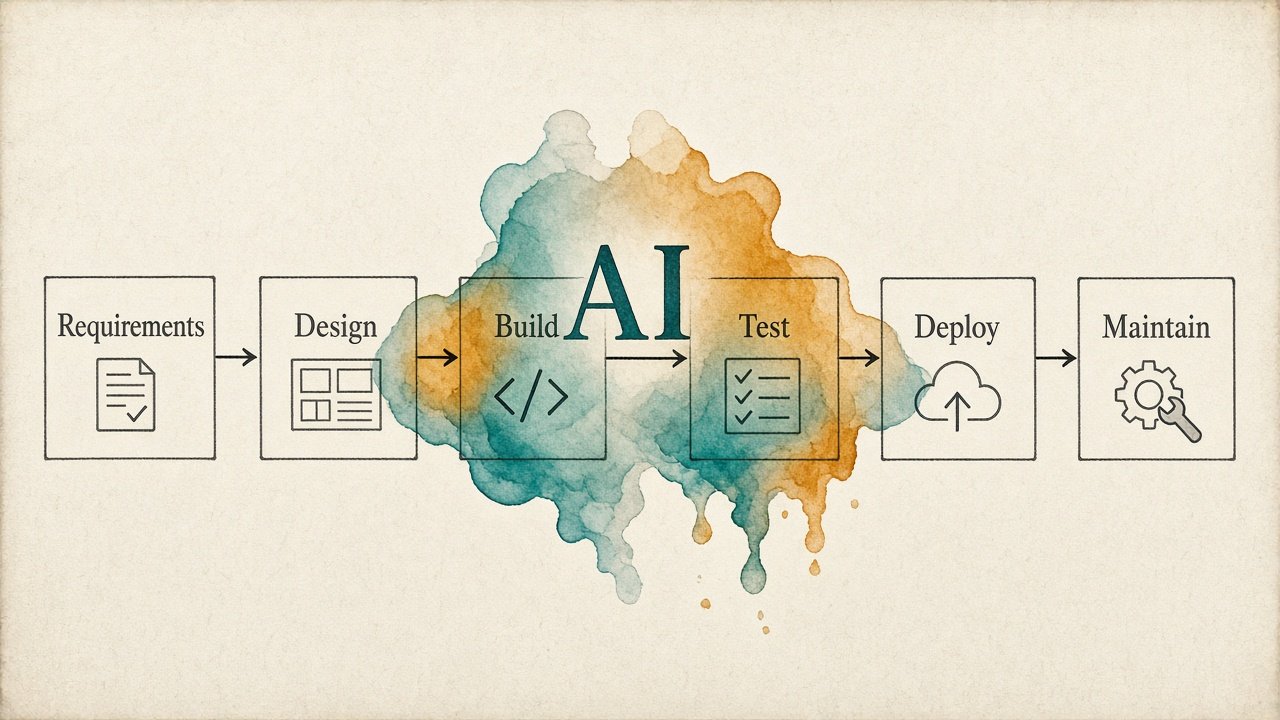
AI did not retire system analysis for web development in 2026. It moved the scarce work upstream: clear requirements, contracts, and verification — while UI demos got cheaper.
The product owner opens a shared link on Monday. By Wednesday the AI has produced a checkout flow that looks shippable: screens, copy, even a sketch of the payment step. Nobody has yet written down what happens when the warehouse management system returns a late ASN, or when the loyalty service is in a partial outage. The mockup is fast. The system is still undecided.
That gap — plausible interface, unfinished behaviour — is where system analysis for web development sits in 2026. AI did not retire the role. It moved the scarce work upstream.
From 2022 to 2026 — what actually moved
In 2022–2023, assistants mostly sat beside the keyboard: autocomplete, doc lookup, small refactors. Analysts still owned workshops, use cases, and acceptance criteria in familiar formats. The novelty was coding speed, not requirements craft. A good BRD still took stakeholder time because someone had to ask the awkward questions in the room.
By 2024–2025, generation crossed the boundary into analysis artefacts themselves. First drafts of user stories, process diagrams, API sketches, and test outlines arrived in minutes. Teams that treated those drafts as finished work discovered a new failure mode: documents that read complete and still omit the edge that breaks production. The workshop did not disappear. It just started later, against a document that already looked authoritative.
2025’s research picture is blunt. Industry measurement framed AI as an amplifier of whatever delivery system you already have — strengths and dysfunctions alike — with high adoption and a widespread belief that productivity rose.
Companion analysis in early 2026 named the bill that follows the speed: a verification tax, where time saved writing is often re-spent reviewing, and a large share of practitioners report little or no trust in AI-generated code.
A controlled study of experienced open-source developers in early 2025 found they were slower with AI tools on real issues in familiar large repositories, even while believing they had sped up. For analysts, the parallel is uncomfortable: an AI-authored requirements pack can feel “done” while the integration contract is still fiction.
Into 2026, web estates see the same pattern at system scale. UI and happy-path flows compress. Cross-service behaviour, data ownership, and non-functional requirements do not. The analyst who only polishes AI prose is doing the easy half of the job.
2027 tendencies — spec as fuel
Near-term tendency is not “no humans in the loop.” It is spec-driven and agentic delivery: agents implement against artefacts that look like analysis products — structured requirements, interface contracts, acceptance suites. Work on that shift already argues the obvious consequence: agentic speed without rigorous up-front formalisation degrades output quality.
So the analyst’s centre of gravity moves. Less time formatting the first draft. More time deciding what must be true before generation is allowed to run, and what evidence closes a phase. The lifecycle chart from textbooks — requirements, design, build, test, deploy, maintain — does not vanish. AI shows up inside several boxes at once. Someone still has to own when a box is honestly complete.
Expect more pressure to ship “working” screens earlier, and more need for analysts who can refuse a demo that lacks a contract. The title on the badge may vary. The skill does not.
What got simpler — and what got harder
Simpler:
- First drafts of screens, stories, and sequence sketches.
- Exploring alternatives in a workshop without waiting for a sprint of design time.
- Translating a stakeholder sentence into a structured candidate requirement.
- Filling boilerplate: role lists, glossary seeds, standard CRUD story shapes.
Harder:
- Keeping truth separate from fluency. Plausible text is not validated behaviour.
- Integration and exception paths. Qualitative work behind the 2025–2026 findings keeps returning to the same gap: prototyping accelerates; production-grade integration does not, and estimates that ignore that gap under-fund the real work.
- Trust and review design. When a large share of practitioners report little or no trust in AI-generated code, “we’ll catch it in QA” is not a strategy — it is a hope.
- Non-functionals under speed pressure. Latency budgets, audit trails, accessibility, and privacy constraints get skipped in AI-first prototypes unless someone names them early.
- Teaching juniors. Editing generated drafts is not the same as learning to spot a missing exception.
Running example: a mid-market ecommerce team. AI drafts a returns portal in a day. The portal still has to talk to the WMS, the payment capture for partial refunds, and the fraud queue. The happy path looks finished. The late-ASN and partial-refund paths are where the analysis either exists or the incident starts.
What to pay attention to
Watch the phase exits, not the demo. A screen that impresses in a review can still lack a data contract, an idempotency rule, or an owner for a failure mode. Ask what evidence would falsify “ready for build.”
Watch AI in the product separately from AI in the delivery toolchain. If the web system embeds a language-model feature, the requirements pack needs abuse and failure cases: untrusted instructions in user content, unsafe output rendered into pages, and leakage of context the model should never have seen. Treat those as requirements, not as a later security surprise.
Rapid prototypes also tempt teams to cut analysis and integration time. Adjust estimates for the distance between sketch and production readiness, or the amplifier effect works against you.
Skill depth is quieter to notice. Juniors who only edit AI drafts may never learn to spot the missing exception. Apprenticeship has to include review of AI output against real failure modes — the late file, the silent integration failure, the permission that drifted.
And shared ownership of generated artefacts: “The model wrote the BRD” is not a sign-off. Someone named has to accept the risks the document claims to cover.
Analyst checklist — extend the craft
Use this as a skill-extension list, not a ceremony. Bake the slot into the label so the list survives Medium’s numbering quirks.
- Ambiguity hunt — Before accepting an AI draft, mark every noun that could mean two systems (order, shipment, customer, balance). Force one definition per noun.
- Contract before canvas — Write the interface and data contract for the hardest integration before polishing UI generated from the happy path.
- Exception catalogue — List the failure modes that actually happen on your estate (timeout, partial success, late upstream). Require acceptance criteria for each.
- Verification design — Decide what evidence closes the story: automated check, dual review, or production probe. Do not leave “AI suggested it” as the gate.
- NFR first pass — Latency, audit, accessibility, privacy, and rollback: one sentence each before codegen scales the omission.
- AI-in-product addendum — If the feature uses a model in the user path, add abuse cases and define unsafe-output handling before UX polish.
- Estimate the gap — Split “prototype” and “production-ready integration” in the plan so the verification tax is funded.
- Teach the review — Pair on one AI-generated artefact per sprint and narrate what was wrong. That is how the craft extends past the tool.
None of these require a new tool seat. They require attention you can practice on the next ticket.
The chart still needs an owner
Picture the traditional lifecycle again: requirements, design, build, test, deploy, maintain. AI did not erase the boxes. It showed up inside several of them at once — drafting, suggesting, sometimes implementing. The chart still needs someone who decides when a box is honestly complete.
In 2026 that someone is still a system analyst in spirit, whether or not the title says so. The typing got cheaper. The truth did not.
Talk to me about requirements that survive AI-assisted delivery